




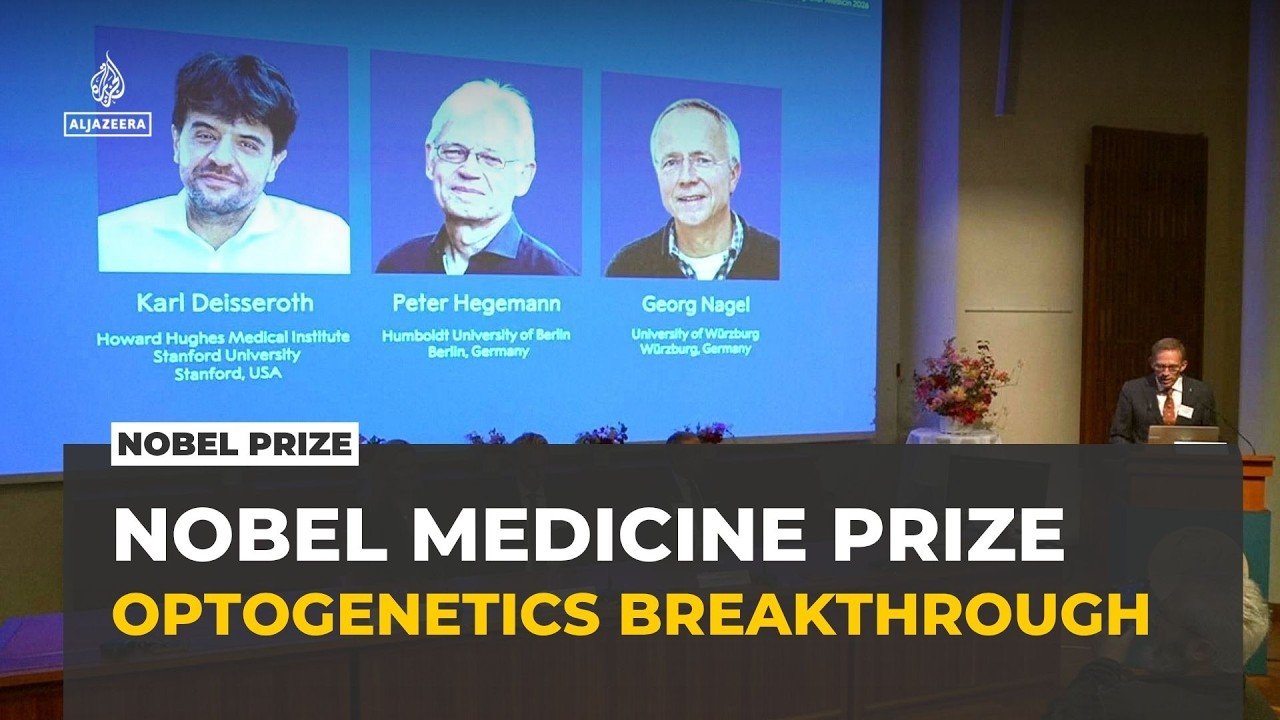
The 2026 Nobel Prize in Physiology or Medicine has been awarded to American scientist Karl Deisseroth and German scientists Peter Hegemann and Georg Nagel for pioneering work in optogenetics, a technique that uses light to control nerve-cell activity and has transformed scientists’ understanding of how the brain works. Hegemann and Nagel’s research into light-sensitive proteins in algae helped lay the foundations for the technique, which Deisseroth later combined with nerve cells to allow researchers to switch individual neurons on or off and study their role in behaviours including learning, fear, memory and movement. The Nobel Committee described the discovery as a new era in neuroscience, while researchers are also exploring potential medical applications, including treatments for some forms of blindness and more precise stimulation for cochlear implants. The three laureates will share a prize of 12 million Swedish crowns, about $1.2m.
Al Jazeera’s Paul Rhys, reporting from Stockholm, says the work began with research into pond algae and has since fundamentally changed the way scientists study the brain.
Subscribe to our channel: http://bit.ly/AJSubscribe
Follow us on X: https://X.com/AJEnglish
Find us on Facebook: https://www.facebook.com/aljazeera
Check our website: http://www.aljazeera.com/
Check out our Instagram page: https://www.instagram.com/aljazeeraenglish/
Download AJE Mobile App: https://aje.news/AJEMobile
#NobelPrize #NobelMedicine #Optogenetics #Neuroscience #BrainResearch #KarlDeisseroth #PeterHegemann #GeorgNagel #Science #Medicine